There's a specific kind of British hardship that doesn't show up in the cost-of-living headlines about energy bills or supermarket prices and that is the moment someone can no longer afford their broadband which in turn causes everything downstream of that decision starts to go wrong at once. No online banking to catch a missed payment before it becomes a charge. No email to chase the job application. No way to manage a Universal Credit claim, which is digital by default and increasingly assumes you're never offline. The internet stopped being a "nice-to-have" choice some years ago. For a growing number of people, it's now the thin wire holding the rest of their finances together and that wire is fraying at exactly the moment people can least afford it to.
This piece looks at four data trends that, on their own, tell four separate stories about a country under financial strain. Put next to each other, they tell one story.
The debt is rising
UK households aren't just feeling squeezed, they're borrowing to cope with the squeeze. Outstanding consumer credit (unsecured borrowing: credit cards, personal loans, car finance, overdrafts) sat around £180 billion in 2015. It's now over £250 billion.
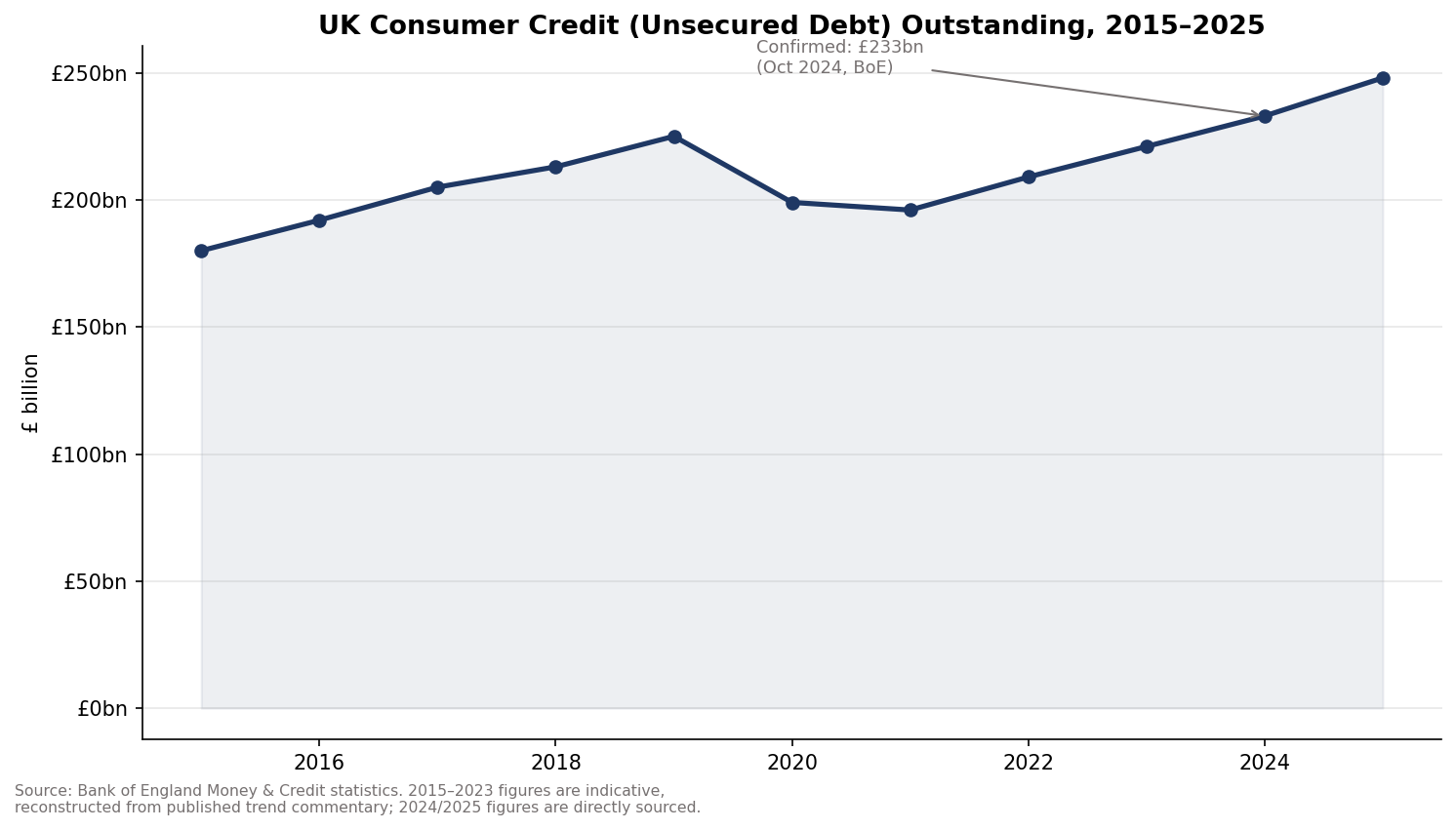
The dip in 2020–21 isn't a recovery story, it is pandemic-era spending collapsing, not debt being paid down out of newfound strength. Since 2022, the line has gone almost straight back up, driven by the same cost-of-living pressure showing up everywhere else in this piece.
When debt tips into default
Rising debt is a warning sign. Debt Relief Orders are what happens after the warning is ignored and a formal insolvency route, specifically for people with low income and next to no assets, who genuinely cannot pay what they owe. It's about as close as UK data gets to a direct measure of "ran out of road."
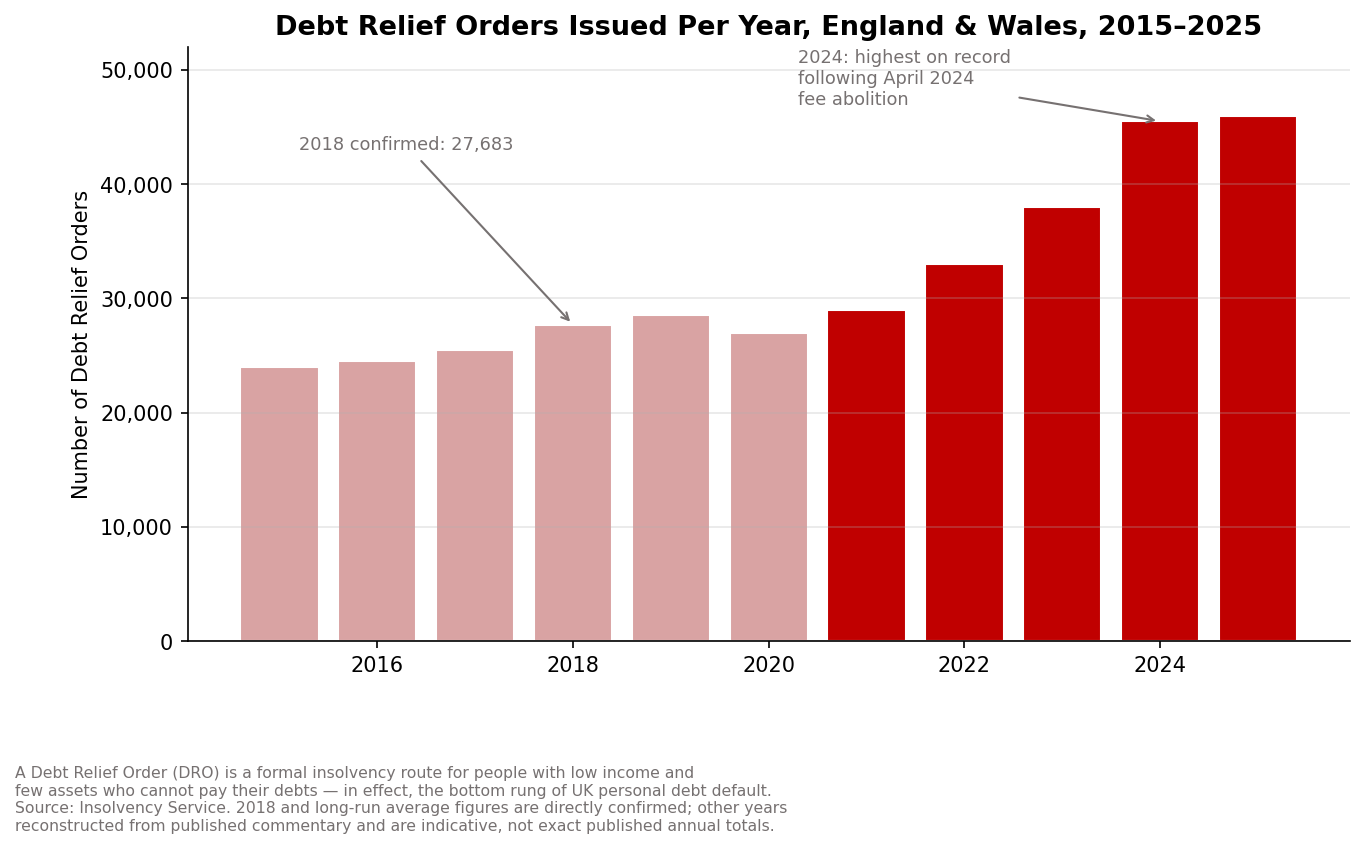
DROs sat in a fairly flat band through most of the 2010s. From 2021 they didn't just rise, they nearly doubled in three years, and 2024 was the highest annual total on record, a trend in the government's own Insolvency Service links partly to expanded eligibility and partly to simply removing a £90 upfront fee that had been keeping the poorest applicants out. That detail matters: the fee wasn't stopping people from being in problem debt, it was just stopping them from being counted. Take away a £90 barrier and tens of thousands more people turn out to have needed a DRO all along.
The food bank line hasn't gone back down
Trussell Trust food banks distributed 1.1 million emergency parcels in 2015. In the 2023/24 financial year, that figure hit a record 3.12 million.
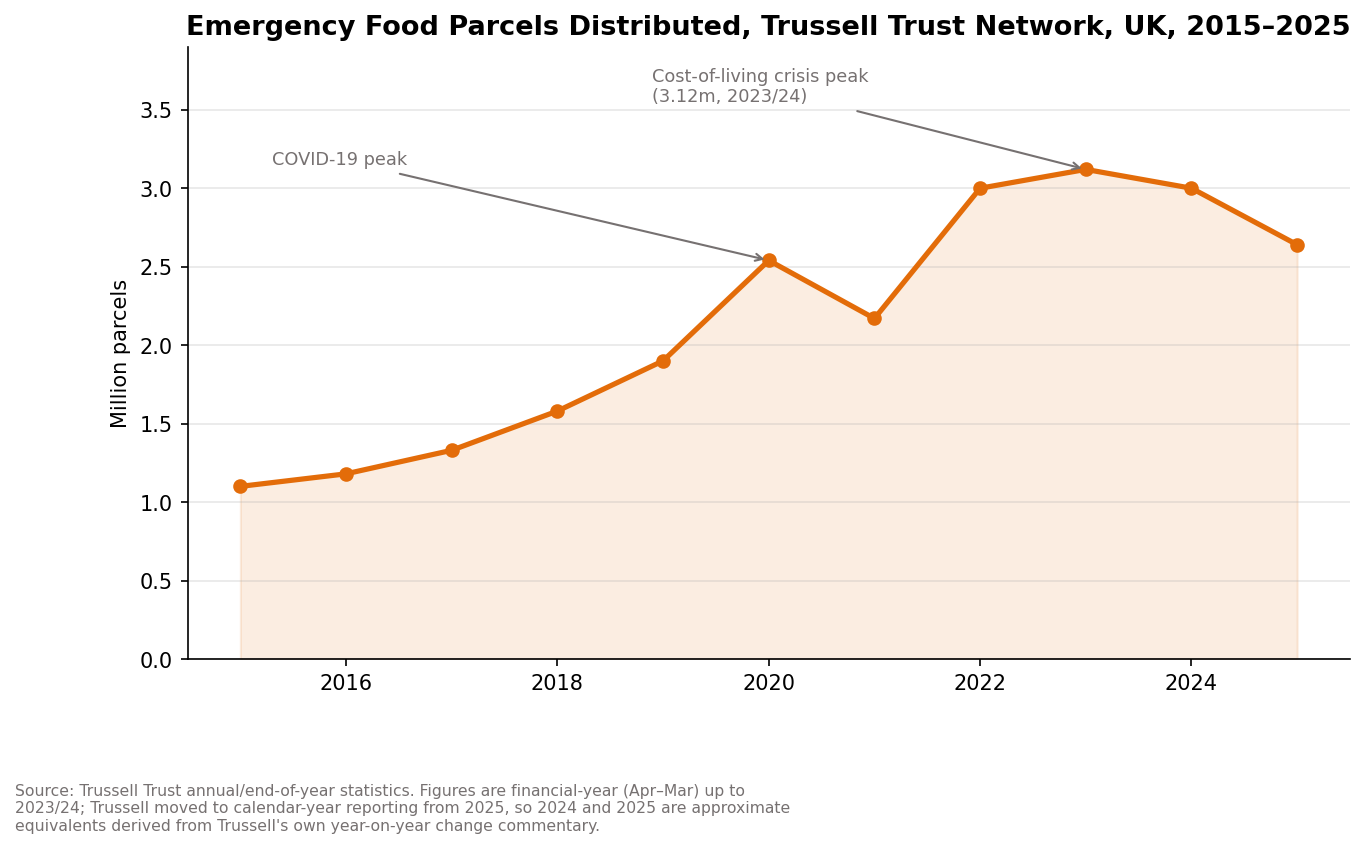
The COVID-19 spike in 2020 is the shape you'd expect from a sudden shock. What's more telling is what happened after: a dip as the economy reopened in 2021, then a climb past the pandemic peak and into record territory through 2022–2024, as inflation and energy costs did more sustained damage than the pandemic itself. 2025's figure of 2.64 million is genuinely a fall from the 2023/24 peak, Trussell itself attributes this to easing inflation helping some people recover but a fall to 2.64 million from a starting point of 1.1 million a decade ago is not a return to normal. It's a smaller record.
The great non-switch
Here's where broadband specifically enters the picture. Ofcom has tracked how many households switch broadband provider each year since 2010. For most of the last decade, that number was remarkably, stubbornly low: 8-10%, essentially flat, even as full-fibre competition expanded, and cheaper alternative providers became available across most of the country.
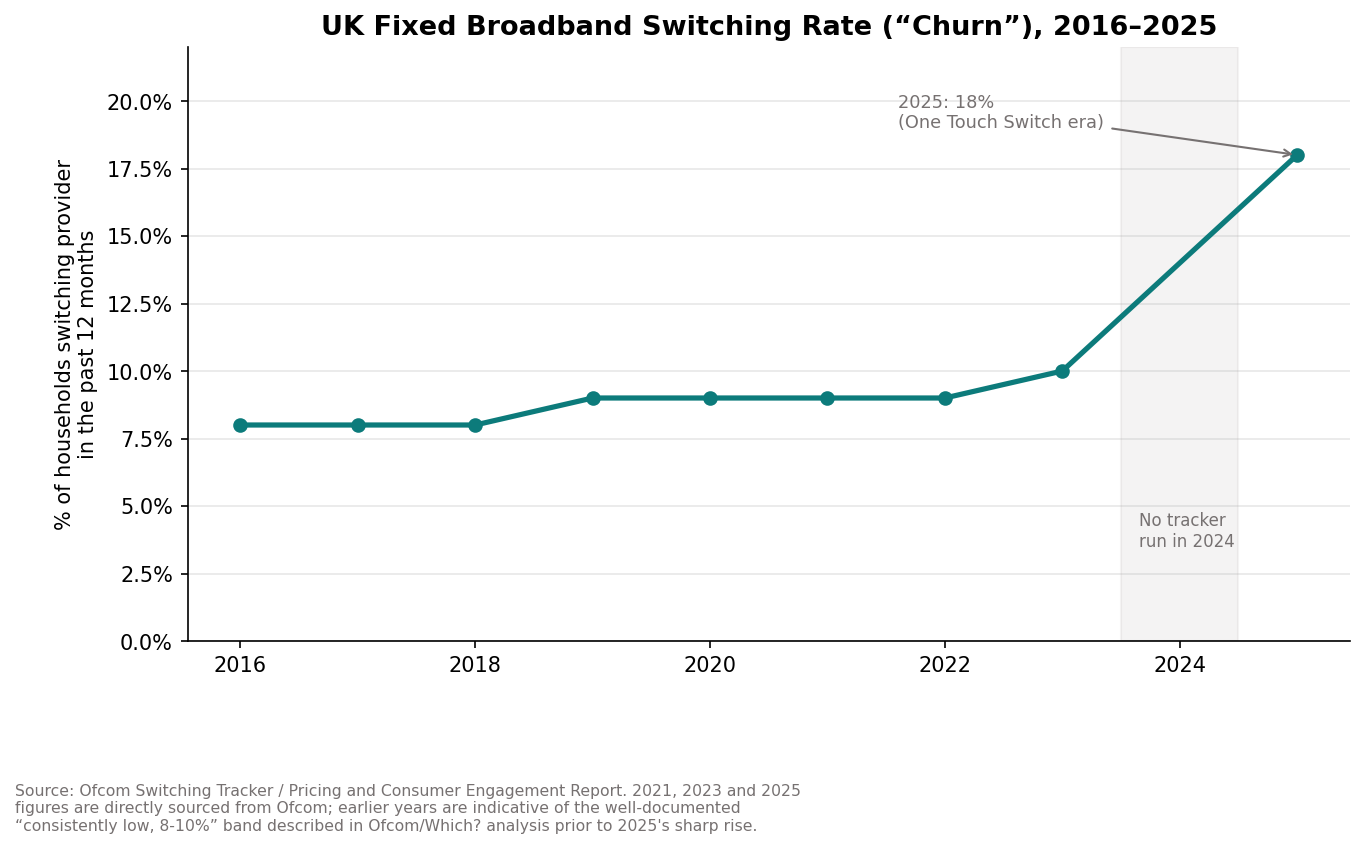
Something did finally shift in 2025: switching jumped to 18%, roughly double the historic rate, coinciding with Ofcom's "One Touch Switch" reform making the process genuinely easier (over two million households used it in its first fifteen months). That looks like a competition success story, and to an extent it is. But look at who's actually switching, and the picture gets less comfortable. Ofcom's own 2025 data show only 19% of over-64s switched any communications service in the past year, against 29% of 25-44 year-olds; only 21% of households in the lowest socio-economic group (DE) switched, against 27% of the highest (AB).
In other words: the people most likely to be stuck paying more than they need to are older households, lower-income households, the same groups already showing up in the social tariff take-up figures are the least likely to be the ones taking advantage of a decade-low-priced deal down the road. Cheaper broadband exists. The people who'd benefit most from it are the least likely to go and get it.
Why this particular bill is different
Every one of these four charts would be concerning on its own. Together, they describe a specific mechanism: when money is tight, people cut whatever feels most cuttable, and broadband, a monthly direct debit with no immediate, visible consequence for missing a payment, unlike rent or energy is an obvious candidate. But cutting it doesn't just remove entertainment. It removes the ability to manage the debt that's already piling up, apply for the jobs that might ease it, or claim the benefits designed to help. Losing internet access doesn't happen after someone falls into poverty. Increasingly, it's one of the things that tips them into it quietly, a few weeks after the direct debit bounces, well before anyone else notices.
Then add AI to the mix
Everything above describes a two-tier internet economy that already existed. Generative AI is now opening a second, faster-moving divide on top of it.
UK adoption of AI tools has moved fast: Ofcom's tracking shows consumer use rising from 23% of adults in 2023 to 31% in 2024 to 54% by late 2025. But that headline hides a sharp income skew. One UK study tracking AI search adoption by household income in 2025–26 found usage of around 30% in higher-income (£50–60k+) households against roughly half that in lower-income brackets -higher earners are, on their own figures, more than twice as likely to be using generative AI tools regularly. Separately, polling from the Tony Blair Institute and Ipsos in mid-2025 found nearly half of UK adults hadn't used any generative AI tool in the previous 12 months at all.
That gap compounds everything else in this piece, rather than sitting alongside it. AI tools are already functioning as a genuine multiplier for the people who have reliable access and the confidence to use them: drafting a CV and cover letter in minutes, negotiating a phone contract, understanding a tenancy agreement, checking benefits entitlement, learning a new skill for free. Every one of those is disproportionately useful to someone under financial pressure and disproportionately unavailable to them, because the same low-income, lower-confidence households already least likely to have full connectivity or to switch to a cheaper broadband deal are also the households least likely to be using AI tools at all. The individuals most likely to benefit from "intelligence on steroids" are, on the current evidence, the ones least likely to have it.
Thinking through the solutions
None of these fix the underlying affordability problem on their own, but each addresses a different piece of it.
Make the safety net actually reach people. Broadband social tariffs already exist, priced from around £12–13 a month, and take-up still sits below 10% of those eligible. Automatic enrolment which links eligibility to Universal Credit or Pension Credit data the way some council tax reductions already work would fix an awareness problem that a decade of voluntary sign-up hasn't solved.
Widen who funds universal access. The UK's broadband Universal Service Obligation currently puts almost the entire cost of guaranteeing a baseline connection onto two companies, BT and KCOM, rather than the industry as a whole. A broader industry-funded model, similar to universal service funds used elsewhere, would spread that cost and could plausibly extend beyond "a bare minimum connection" into ongoing affordability support.
Build switching into the safety net, not just the market. If the people least likely to switch are the same people struggling most, "cheaper deals exist" isn't a solution by itself. What would be proactive is targeted nudges such as providers or Ofcom directly flagging when a customer on a low income is paying above the cheapest available tariff. This would close a gap that One Touch Switch alone hasn't closed.
Redirect the savings digital services already generate. National and local government have cut real costs by pushing services online. Some portion of that saving, formally tracked and redirected into connectivity subsidy, would at least connect the saving to the thing that made it possible.
The Coucal solution. One option worth taking seriously on its own terms: "gamifying" access the way free-to-play games already gamify continued play. Watch a short advert and your game continues without paying the same mechanic. This applied to connectivity itself, would let someone who can't afford a full contract watch an advert, complete a short survey, or opt into sharing specific information in exchange for credited data or access. It could be layered, with a baseline of ad-funded access topped up by further credit for survey completion or data-sharing converting attention and information into connectivity rather than requiring cash up front.
The appeal is practical rather than ideological: it doesn't need new legislation, a government scheme, or industry-wide agreement to exist. An ISP or mobile network could build it and launch it commercially on its own. This will put the businesses actually buying that attention, many of which are the same local and national businesses that benefit every time someone in their area is online, directly in the position of funding the access, rather than routing everything through pricing or the benefits system.
It isn't a free lunch, and it's worth being honest about that rather than presenting it as a clean fix. Someone who can afford a normal contract will simply skip the adverts and surveys; someone who can't will pay with their time, attention, and personal data instead is still a cost, just a harder one to see on a bill, and one that falls, by construction, only on people who couldn't afford to opt out of it. Meta's "Free Basics" ran a version of this idea across a number of developing markets and was banned in India in 2016 for exactly this reason: regulators judged it was creating a permanent second-tier internet for people who could least afford to demand better, rather than a stepping stone to full access. Any UK version would need a real answer to that critique a route off the ad-funded tier and onto full connectivity, not just onto it before it could be more than a sticking plaster over the affordability gap this piece has been describing.
The point that ties it together
Rising debt, rising defaults, record food bank use, and a broadband market where the people most exposed to all three are the least likely to switch to something cheaper, or to have the AI tools now reshaping how everyone else navigates money, work and daily admin. These aren't four separate crises running in parallel, they are one mechanism, compounding. Connectivity used to be one household expense among many. For a growing number of people, it's the expense that decides whether the others stay manageable at all and every year it becomes a little more unaffordable for exactly the people who can least afford for it to be.