Connectivity has stopped being a discretionary purchase. It's the substrate everything else runs on: commerce, government services, education, job applications, banking. That's true for an individual household deciding whether it can afford broadband this month, and it's just as true, at a completely different scale, for a continent deciding how, and by whom, its digital infrastructure gets built. This piece is about that second scale: the gap between Africa and Europe's internet access, the surprisingly practical ideas already circulating in African markets for closing it, and the great-power competition quietly playing out underneath the whole question.
The gap, in one number
As of 2025, 92% of Europe's population uses the internet. In Africa, it's 36%.
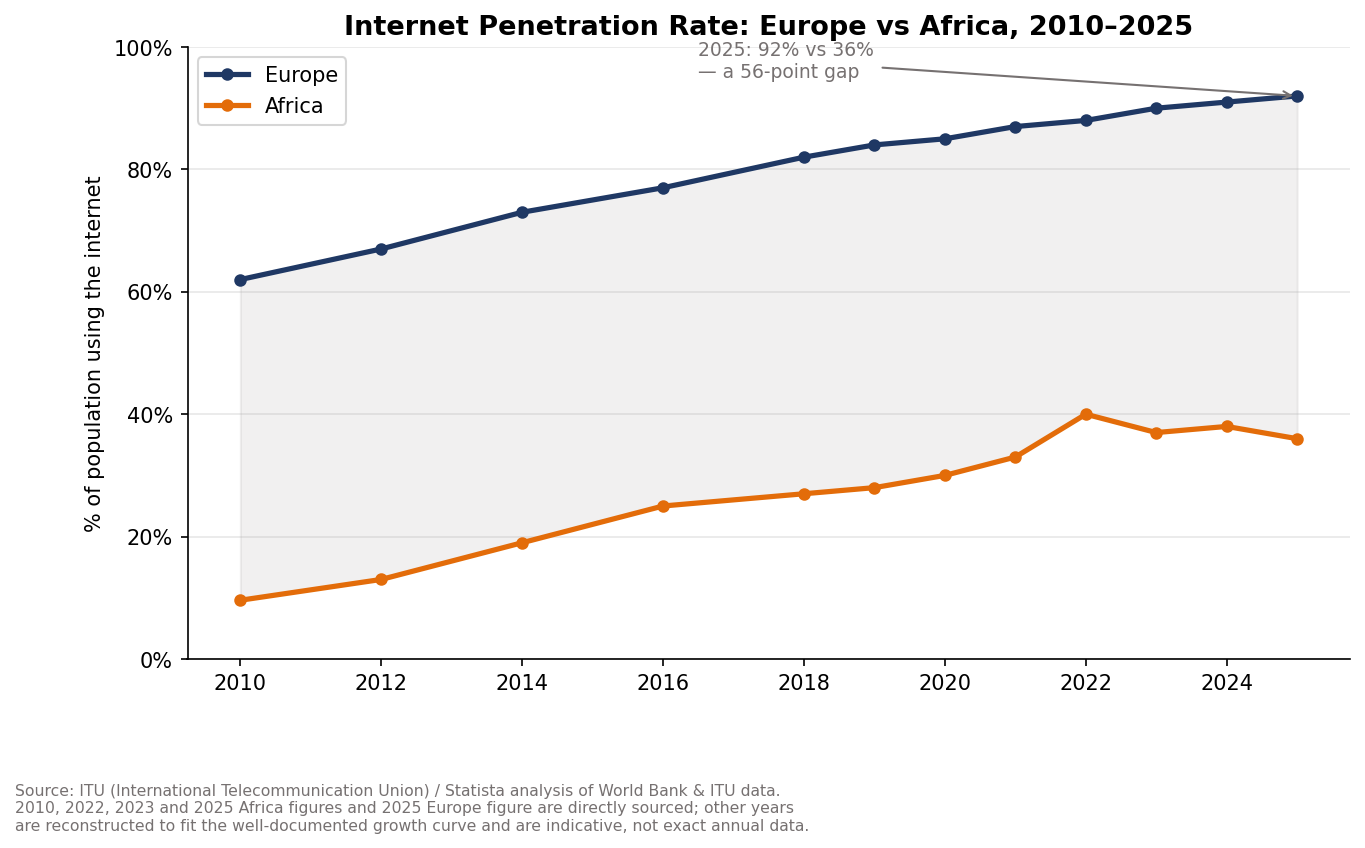
That's a 56 percentage point gap between two continents separated by a few hours' flight. It's also a gap that's closing in relative terms. Africa's penetration rate has roughly quadrupled since 2010, while the absolute number of people it represents keeps growing, because Africa's population is growing too. Africa had 181 million internet users in 2014. By 2024 that had reached 646 million. By 2029 it's projected to pass 1.1 billion.
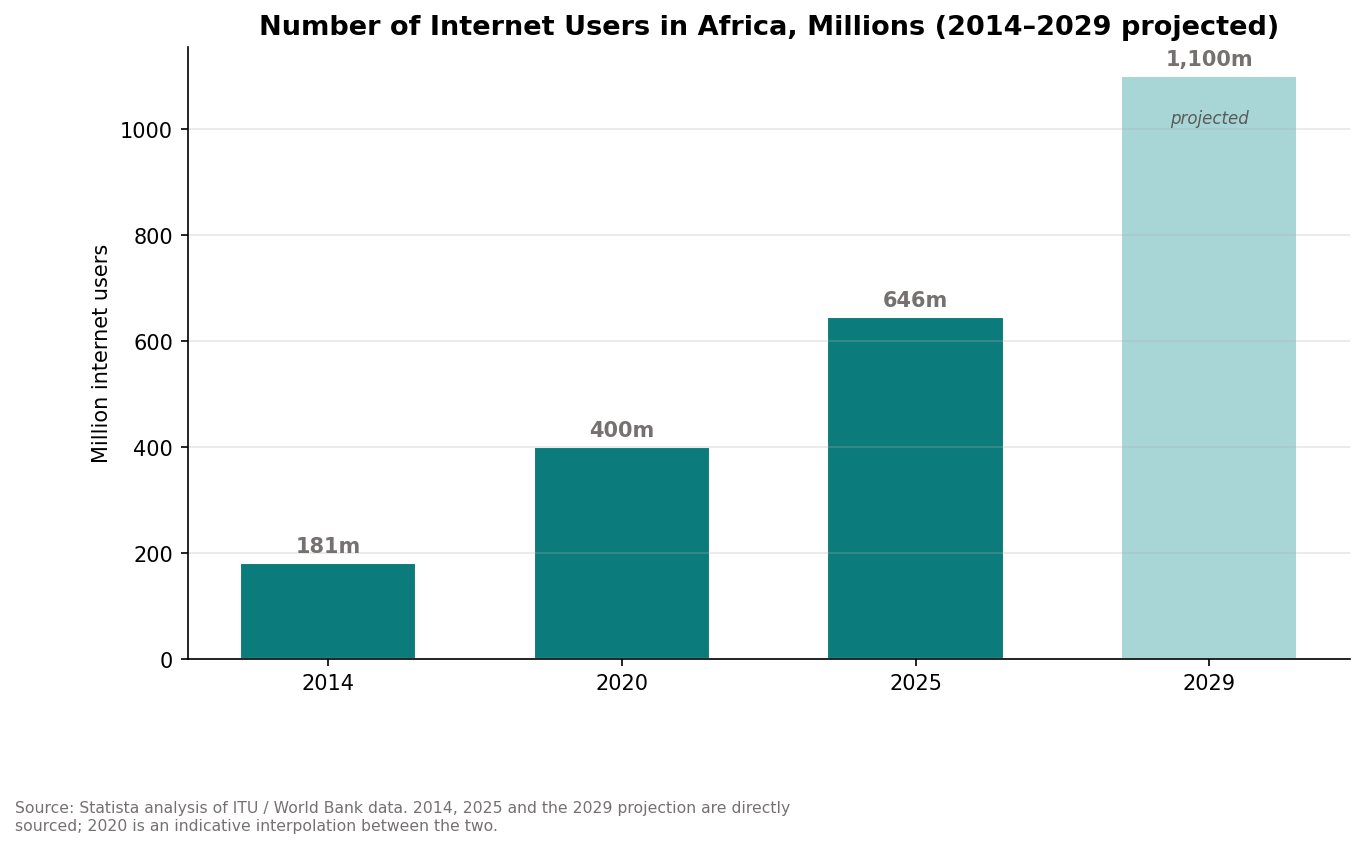
That trajectory is the whole story in one chart: this isn't a niche connectivity problem in a handful of poor countries. It's the wiring-up of what will be, within a generation, the largest working-age population on Earth. Whoever builds that network, and on what commercial terms, has a stake in one of the biggest economic and political stories of the century.
The building blocks for solving affordability are already scattered across the continent
Affordable connectivity for low-income households is usually discussed as a subsidy problem: who pays, and how much. Several African markets have been quietly assembling a different kind of answer, not a subsidy, but a change to the unit you're billed in, small enough that "affording internet" stops being a monthly decision and becomes a daily or even hourly one. None of these are complete solutions on their own, and none has been proven at national scale yet. But taken together, they show the raw materials for a genuinely different model already exist and are being actively tested in the market, not just theorised.
Fibertime, South Africa. Founded in 2022, Fibertime runs fibre into townships, the low-income, historically underserved urban areas where, per South Africa's own ICT regulator, roughly 80% of homes still lack access to fast, affordable broadband despite mobile penetration exceeding 100%. Instead of a monthly contract, customers buy a R5 (roughly 25p) voucher for 24 hours of uncapped, unthrottled 100Mbps fibre, paid through a linked mobile wallet (VulaCoin) that also activates the connection. No credit check, no debit order, no 12- or 24-month contract, free installation and router. It started with 880 homes in one township outside Stellenbosch in November 2022; by 2025 it had passed 200,000 connected homes across 25 townships in six cities, with a stated target of 2 million homes by 2028, and Nokia now supplying the access infrastructure at scale. That's real, verifiable growth; however it's still a fraction of the roughly 80% of South African homes the regulator says remain unserved, and it depends on township-specific network economics that won't automatically transfer to, say, a sparsely populated rural area.
Kenya's "Poa!" network. ISP Poa! built a public Wi-Fi mesh of over 3,000 hotspots across low-income Nairobi neighbourhoods such as Kibera, Kawangware, Kangemi and others, letting anyone pay Sh10 (about 6p) for an hour or Sh50 for a day of uncapped access, no contract or subscription required. Alongside it, Mawingu Networks, which started life in 2014 as a non-profit bringing electricity to rural areas, now runs a wireless ISP specifically targeting rural Kenyan households the fibre operators don't reach.
Nigeria's version of the same instinct, applied to hardware. Nigeria's constraint is often the device rather than the connection. Sun King's PayGo model finances smartphone ownership in small instalments rather than one large upfront cost, explicitly aimed at the young people, women and low-income households priced out of a single lump-sum purchase, while Nigerian ISPs like Tizeti have built solar-powered, off-grid infrastructure to cut both connectivity and energy costs simultaneously.
What makes granular, sub-30p payments like these viable at all, rather than collapsing under payment processing fees, is a piece of infrastructure that's already in place across much of the continent: mobile money. Kenya's mobile money penetration hit 91% of adults by mid-2025; M-Pesa alone has around 70 million active users across Africa and processes upwards of $450 billion a year in transaction volume. Micropayments that would be swallowed by card fees and direct debit overhead in a market without that infrastructure are simply routine there. That's the real building block worth paying attention to, not to say that any single company has cracked affordable connectivity nationwide, but that the payment rails needed to make a pay-as-you-go model work at very small transaction sizes already exist, at scale, independent of any one ISP's success or failure.
Why this is also a geopolitical story
None of this infrastructure builds itself, and who's paying for the parts underneath the consumer-facing pay-as-you-go layer matters just as much as the pricing model on top.
China has been the dominant builder of Africa's digital backbone for the past decade. Huawei alone is estimated to have built around 70% of Africa's 4G mobile networks. Chinese state policy banks have extended an estimated 57 loans worth $4.7 billion across 24 African countries specifically to fund Huawei-implemented telecoms infrastructure, financing on terms and timelines Western commercial lenders generally won't match, part of the "Digital Silk Road" strand of China's Belt and Road Initiative launched in 2015. The appeal to African governments is straightforward: cheaper, faster-financed infrastructure now, from a supplier willing to build in markets Western firms have often judged too commercially marginal to prioritise.
The costs are less immediately visible but real. In 2018, Reuters reported that computers built for the African Union's headquarters in Addis Ababa, a Chinese-funded and constructed building, had been transferring data to servers in Shanghai every night for five years before the breach was discovered. Beyond any individual incident, the broader concern raised by researchers and Western governments alike is dependency: once a country's core network equipment, standards, and maintenance relationships run through a small number of Chinese firms, meaningfully switching supplier later is expensive and slow, which is itself a form of leverage.
Europe's answer, the Global Gateway initiative, aims to mobilise up to €300 billion globally by 2027, but by its own advocates' admission, it has largely stayed out of the terrestrial fibre-laying that Huawei dominates, and has no coordinated answer to low-earth-orbit satellite connectivity, where Starlink is expanding aggressively and China is developing its own competing constellation. The US, meanwhile, has spent years warning African governments about the security risks of Chinese telecoms equipment while offering comparatively few affordable alternatives of its own. Microsoft and Emirati firm G42's $1 billion Kenyan data centre investment is a rare recent exception, not the norm.
Layered on top of the state actors is Meta, which has quietly become one of the largest private infrastructure investors in Africa, laying undersea cables and, more recently, committing to roughly 900km of terrestrial fibre in Zambia and 2,000km across the Democratic Republic of Congo, framed as a "digital corridor" connecting the Atlantic and Indian Ocean coasts. That infrastructure investment isn't separate from Meta's other major African connectivity programme, Free Basics, which brings us to the question this piece was actually asked to answer.
The Coucal solution: gamifying access instead of subsidising it
Free-to-play mobile games have run the same mechanic for years: watch a short advert, and your game continues without paying anything. The "Coucal" model applies that same logic to internet connectivity itself. Instead of a monthly bill or even a pay-as-you-go voucher purchased with cash, someone who can't or doesn't want to pay watches a short advert, completes a brief survey, or opts into sharing specific information, and receives credited data or connection time in return. It can be layered: a baseline of ad-funded access, topped up with further credit for completing a survey or sharing data, converting attention and information into connectivity rather than requiring money up front.
The appeal is practical. It doesn't need a government programme, new legislation, or industry-wide agreement to exist, just a mobile network or ISP could build and launch it commercially on its own. And it puts the businesses actually buying that attention directly in the position of funding the access, rather than routing everything through pricing or a subsidy scheme. In a market like Nairobi or Lagos, that could mean hyper-local advertisers, a nearby shop, a local bank, a telecoms brand itself, sponsoring minutes or megabytes for people in their immediate area, a far more targeted and arguably more sustainable proposition than a blanket subsidy funded by government or industry.
It isn't a free lunch, and it's worth being honest about that rather than presenting it as a clean fix. Someone who can afford a normal contract will simply skip the adverts and surveys; someone who can't will pay with their time, attention and personal data instead, which is still a cost, just a harder one to see than a bill. And there's a direct precedent worth reckoning with before treating this as a novel idea: Meta's Free Basics and equivalent zero-rated offers, free access to a curated set of apps and services, paid for by the platform or telecoms operator rather than the user themselves, have been operating for the better part of a decade across Kenya, Nigeria, Rwanda, Ghana, South Africa, Mozambique, Tanzania and beyond, almost entirely without the kind of formal net neutrality regulation that eventually banned the practice in India in 2016. Nigeria's telecoms regulator is, as of 2026, actively designing a new zero-rated education data programme and explicitly studying what went wrong in India and in South Africa and Kenya's own earlier pandemic-era rollouts, in an attempt to get the model right rather than abandon it. Kenya's Airtel has a live, UNICEF-backed zero-rating partnership covering 13 countries, offering free access to educational platforms specifically.
So a close relative of the Coucal model already operates at continental scale, and the debate about whether that's good policy is live and unresolved right now, not hypothetical. The core critique of Free Basics carries over directly: a curated, ad-or-sponsor-funded tier of the internet is not the same as the internet, and deciding which apps and services get zero-rated hands whoever runs the programme genuine gatekeeping power over what "getting online" means for the people using it. Where a version built for African markets could differ meaningfully from Free Basics is in what it's actually funding: general-purpose data credit rather than access to a specific curated app list. If the advertiser is simply buying attention, then a video watched and a survey completed is the exchange for open data credit the user can spend anywhere on the internet, rather than buying a slot inside a walled garden, that preserves open access to the whole internet rather than a curated slice of it, and sidesteps the gatekeeping critique that has dogged Free Basics since 2015. Whether any operator actually builds that more open version, instead of the simpler and more monetisable walled-garden one, is the real test of whether a Coucal-style model would be a genuine improvement on what's already there.
The existing pay-as-you-go infrastructure, such as Fibertime's voucher system, Poa!'s hotspot network, the mobile money rails underneath both, is what would make a general-purpose version practically buildable rather than purely theoretical: the micropayment plumbing, the willingness of low-income users to pay in small, frequent increments rather than one large bill, and the local advertiser base already exist. What's missing isn't the infrastructure. It's a version of the idea designed to spend down into open data credit rather than into a single platform's ecosystem.
The point worth sitting with
A continent deciding whether its digital infrastructure gets built by Beijing, Brussels, Washington or Menlo Park, and a household deciding whether it can afford to stay connected this month, look like completely different problems. They're connected by the same underlying tension: the mechanisms for paying for connectivity remain stuck somewhere between "the person who needs it bears the whole cost" and "whoever subsidises access gets to shape what access means." Africa's pay-as-you-go innovators and its mobile money infrastructure have assembled real, working pieces of a more granular, more affordable answer to the first half of that tension, not a finished solution, but genuine building blocks that a gamified, general-purpose access model could plausibly be built on top of. Nobody has yet solved the second half: who ultimately controls the network, and on whose terms, essentially anywhere.